The Pokémon Company International
Building an employee knowledge system people could trust.
A strategic content redesign for The Pokémon Company International's employee CMS. Return-to-office research consistently surfaced the same underlying issue: employees lacked confidence in where to find accurate, authoritative information. This proposal reframed fragmented documentation as an information architecture and content governance challenge, establishing a scalable foundation for discoverability, consistency, and organizational trust.
Role
UX Strategy, Content Design, Information Architecture
Partners
IT, HR, Legal, Business Stakeholders
Timeline
2021 – 2022
Scope
Employee CMS & Knowledge Ecosystem Strategy, Qualitative Research
Context
01
The original objective was return-to-office readiness. The research uncovered a broader organizational challenge. Information that had once been shared through conversations, office routines, and institutional knowledge now needed to be discoverable, trustworthy, and maintained through digital systems.
In late 2021, The Pokémon Company International was preparing to bring employees in the US and UK back into the office after nearly two years of remote work. I was asked to lead a listening program to understand how employees felt about the transition. It was a research and communications initiative, not a content strategy project.
As the focus groups unfolded, a different pattern emerged. Employees were not just looking for return-to-office guidance. They were struggling to find answers to everyday operational questions and were often unsure whether the information they found was accurate or current.
The organization already had extensive documentation. The problem was not a lack of content. Information was fragmented across disconnected systems and organized around the teams that owned it instead of the employees trying to use it. Finding the right answer often depended on knowing which department published it.
A note on scope: this case study covers the research that surfaced the problem and the IA, content strategy, and platform vision built in response. The platform was a strategic proposal presented to leadership as a result of our listening sessions with TPCi employees.
Research
02
I designed and facilitated the listening sessions myself, then followed an unprompted signal where it led. I developed the discussion guide, facilitated both focus groups, and partnered with a dedicated note-taker to capture anonymized, verbatim feedback. The sessions focused on return-to-office sentiment, safety expectations, caregiving responsibilities, and workplace flexibility—not information architecture or internal content.
Yet the strongest insight emerged without being prompted. Across both the US and UK groups, employees repeatedly described the same frustration: they couldn't confidently find answers to everyday operational questions. They weren't just looking for policies: they were trying to determine which guidance applied to them, where it lived, and whether it was still current.
That recurring theme reframed the project. What initially appeared to be a communications challenge was, at its core, a content strategy and information architecture problem.
"I don't mind looking something up. I mind not knowing whether what I found is the right answer."
— Employee, listening session
"The information is probably somewhere, I just don't know which version I'm supposed to use."
— Employee, listening session
The research reframed the problem. The challenge wasn't creating more content. It was making existing information easy to find, easy to trust, and easy to act on. During a period of rapid organizational change, the result was repeated questions to managers and support teams, inconsistent answers, and reduced confidence in the company's internal knowledge systems.
To validate the finding, I conducted stakeholder interviews and audited the organization's CMS, navigation, and content architecture. The same pattern emerged across departments. Information existed, but it was fragmented and organized around internal ownership rather than employee needs.
Research at a Glance
30+
Research Participants
Employees across US and UK offices representing multiple functions and perspectives.
120+ minutes
Moderated Sessions
Two 60-minute facilitated discussions designed to uncover experiences, pain points, and unmet needs.
Key Insights
Research Protocol
Standardized discussion guide, dedicated note-taking, and anonymized feedback to encourage candid participation.
Problem framing
03
Designing a knowledge system around how employees work, not how departments are organized.
PRINCIPLE 01
Organize by need, not by department
Information is structured around what employees are trying to accomplish, not who owns the content. Whether they're looking for a policy, completing a process, or collaborating with a team, navigation follows employee goals rather than organizational boundaries.
PRINCIPLE 02
Reduce fragmentation through shared governance
Disconnected systems and duplicate, conflicting content were treated as a governance failure to fix, not a content gap to fill with more pages.
PRINCIPLE 03
Support self-service before a support ticket
Every content pattern is designed to answer the question on the page, reducing reliance on repeated one-off requests to managers or support teams.
The redesign
04
How research translated into information architecture and content decisions.
Part 1 · Task-oriented information architecture
01 Navigation reorganized around employee tasks
Top-level categories were rebuilt around what employees were trying to accomplish, like finding a policy, submitting a request, getting IT help, instead of which department published the page.
02 Shared taxonomy across previously disconnected systems
Top-level categories were rebuilt around what employees were trying to accomplish instead of which department published the page.
03 Progressive disclosure for complex policies
Dense policy and process content was restructured to lead with the answer most employees need, with detail and edge cases layered beneath rather than front-loaded.
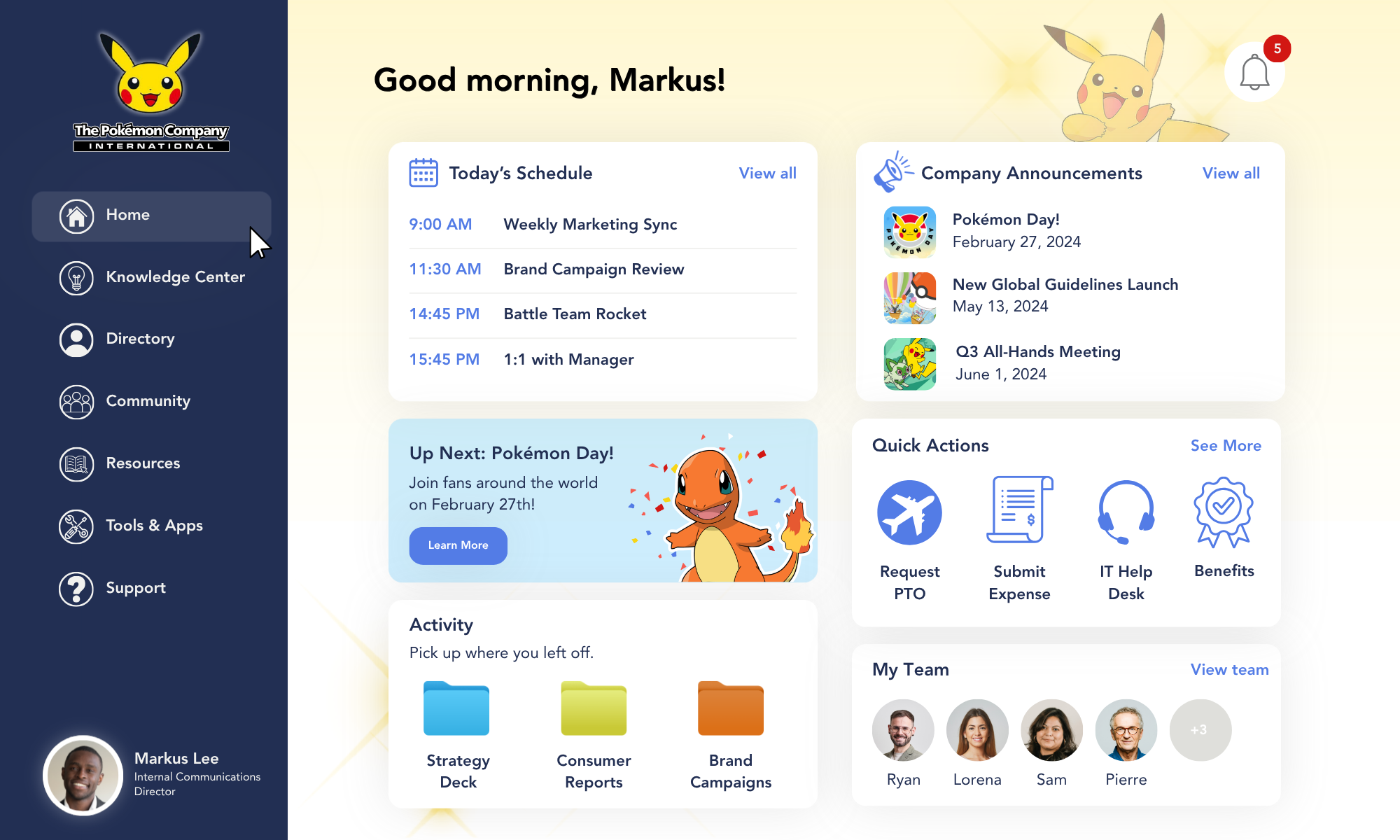
Part 2 · Knowledge Center concept with AI-assisted discovery
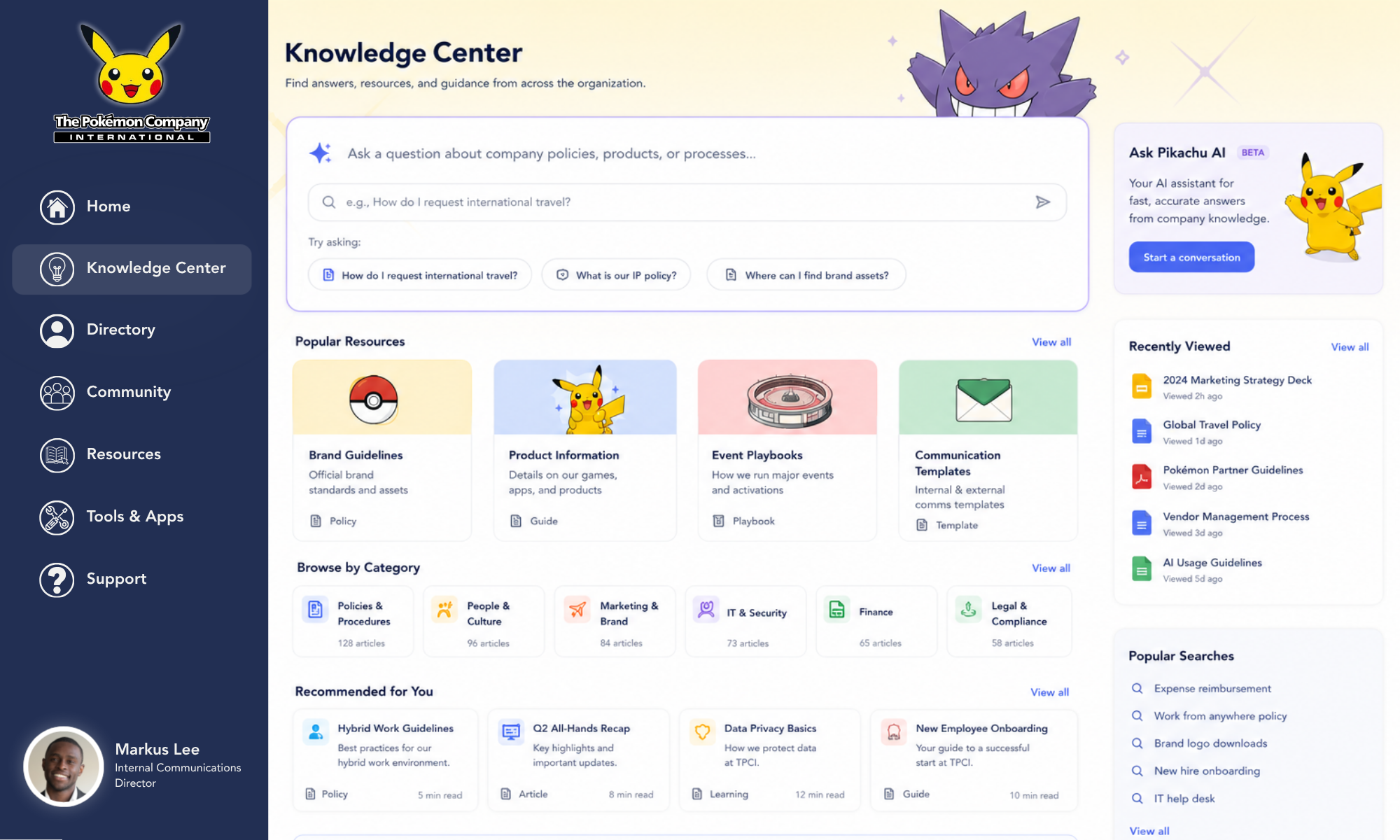
01 A single knowledge center entry point
Rather than a directory of department pages, the proposed Knowledge Center concept gave employees one place to ask a question in plain language and be routed to the current, correct resource.
02 Content governance to keep answers current
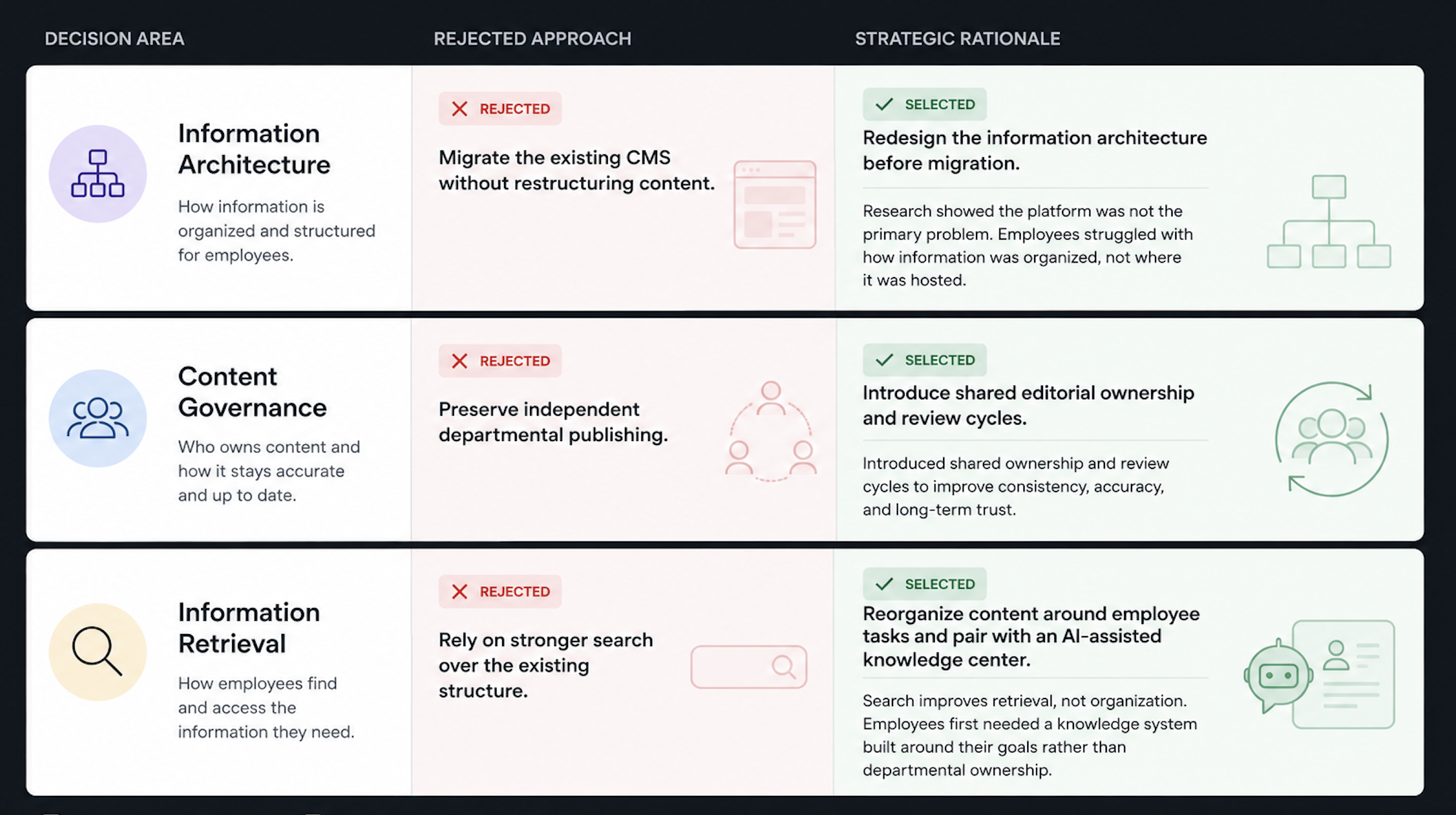
The redesign extended beyond navigation. I proposed editorial ownership, defined review cadences, and governance for high-traffic content so employees could trust that the information they found was accurate, current, and maintained over time.
03 Resource naming in employee language
Information architecture was grounded in employee language, not organizational vocabulary. Navigation, page titles, and categories reflected how employees described their goals and tasks rather than how the business was structured.
Strategic Decisions
Alternatives explored and the rationale behind our choices.
Impact
05
Although this proposal was not implemented during my tenure, it reframed an operational communications challenge as an enterprise content strategy initiative. Its impact is reflected in the organizational decisions it informed and the strategic direction it established, rather than post-launch metrics.
Unified Knowledge System
Proposed a single task-based information architecture to replace fragmented, department-owned knowledge systems.
Established the foundation for scalable navigation, governance, and content discovery.
Research → Strategy
A return-to-office research initiative uncovered a broader organizational challenge, becoming the foundation for an enterprise content strategy and information architecture proposal.
Demonstrates how user research reframed the problem definition.
Executive Alignment
Delivered a strategic recommendation to senior leadership and cross-functional stakeholders across HR, IT, Legal, Communications, and Business Operations.
Built organizational alignment around a long-term content and governance strategy.
This work represents a strategic design proposal rather than a shipped product. The value lies in diagnosing a systemic organizational problem, defining a scalable content strategy, and establishing a clear roadmap for future implementation.
Reflection
06
What I'd revisit, and what I'd carry into any future internal-platform or content strategy work.
What I'd carry forward
Pay attention to the signal outside the brief. The most valuable insight was never part of the original research objectives. Following an unprompted pattern transformed a return-to-office listening initiative into a broader content strategy opportunity.
Diagnose the right problem before designing the solution. A findability problem and a content-volume problem can produce similar symptoms, but they require fundamentally different solutions. Distinguishing between the two has become a core principle of how I approach content strategy.
Systemic change requires organizational alignment. Information architecture and content strategy are only part of the solution. Building executive understanding and cross-functional buy-in is what enables complex organizational proposals to move from recommendation to implementation.
What I'd change
Validate the taxonomy with usability testing. The proposed navigation was grounded in employee research and stakeholder interviews. Given additional time, I would validate the taxonomy through task-based usability testing before presenting the final recommendation to leadership.
Design for content volatility. The proposal established governance for long-lived content, but I would also introduce a lightweight publishing model for information that changes frequently, such as contact information, office hours, and operational announcements.