UC San Diego · Business & Financial Services
Helping thousands of employees navigate complex, fragmented financial information with clarity and confidence.
Led content strategy, information architecture, and AI-assisted content operations for UC San Diego's Oracle Cloud migration, transforming fragmented financial guidance into a scalable, task-based experience for thousands of employees.
SHIPPED PRODUCT · IN ACTIVE USE
Role
Senior Content Strategist
Partners
System administrators, business leaders, functional experts
Timeline
2023 – 2024
Scope
Documentation, workflow guidance, AI content operations
Context
01
A modern enterprise platform, still supported by documentation designed for the system it replaced.
By the time I joined, Oracle Cloud had been live for several years as part of UC San Diego's enterprise transformation from a legacy mainframe financial system. While the platform continued to evolve, its supporting content ecosystem did not. Documentation had become fragmented, outdated, and disconnected from real user workflows, creating unnecessary friction for thousands of employees responsible for navigating complex financial processes.
42,000+
UC San Diego employees (faculty, staff, and contingent workers) with standing access to the Oracle financial system.
SRC: UC San Diego Blink, Oracle Procurement access policy
100+
stakeholders and subject matter experts involved in the original system selection process
SRC: Oracle / Quest Oracle Community case study
3
entities unified onto one shared chart of accounts — campus, Health, and the UC San Diego Foundation
SRC: UC Tech News, FIS go-live coverage
1
of the largest technology improvement programs ever undertaken at UC San Diego
SRC: UC San Diego Enterprise Systems Renewal program
Research
02
Working directly with system administrators, business leaders, and functional experts to find where guidance was breaking down.
Working with system administrators, business leaders, and functional experts across Business & Financial Services, I traced the real problem: The breakdown was that documentation, training, and self-service guidance were still written for the old mainframe's logic, just dressed up with a new interface, so people were being set up to think about the tool in exactly the wrong way.
"I know what I'm trying to do. I just can't tell which of these six menu paths actually does it."
— Business & Financial Services staff member, internal feedback session
"Every department wrote their own cheat sheet for the same process, and none of them agreed with each other."
— Functional expert, enterprise documentation review
Two things kept showing up over and over. First, Oracle never stopped changing: it pushed updates every quarter, and the documentation just never caught up, so people were learning a version of the system that didn't quite exist anymore. Second, because there was never one shared standard, departments had quietly started writing their own guides on the side. So depending on who you happened to ask, you could get three different answers for the exact same task.
Problem framing
03
Designing a documentation system resilient to continuous platform change.
Principle 01
Documentation has to move at the system's speed
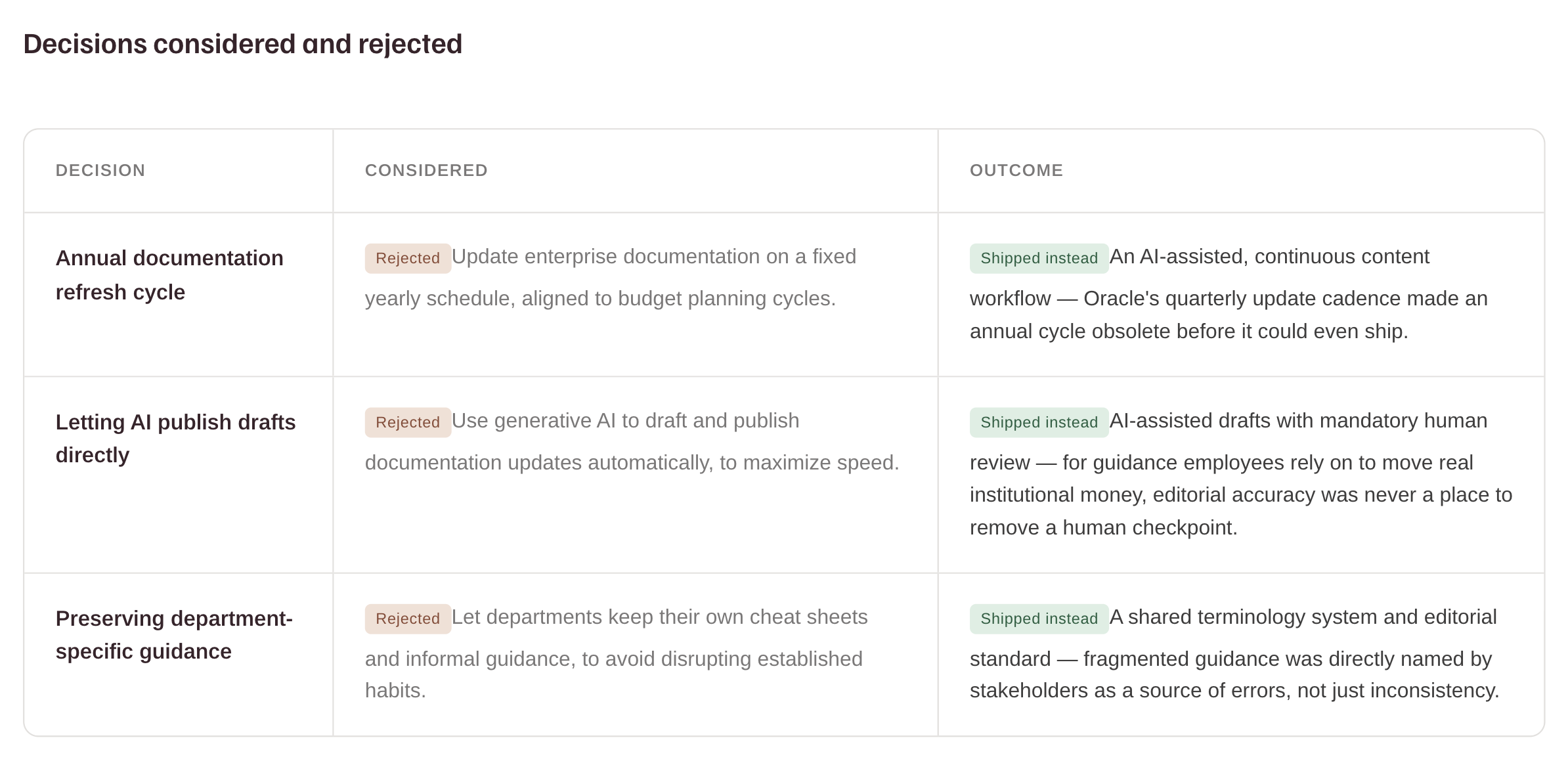
Quarterly platform updates meant content workflows needed to be fast and repeatable, not a once-a-year documentation overhaul.
Principle 02
AI accelerates drafts, humans own accuracy
Generative AI speeds up first drafts and synthesis, but every piece of guidance is reviewed and owned by a person before it reaches an employee making a real financial decision.
Principle 03
One terminology system, not one per department
A shared taxonomy and editorial standard replaces department-specific cheat sheets, so the same process reads the same way everywhere it's documented
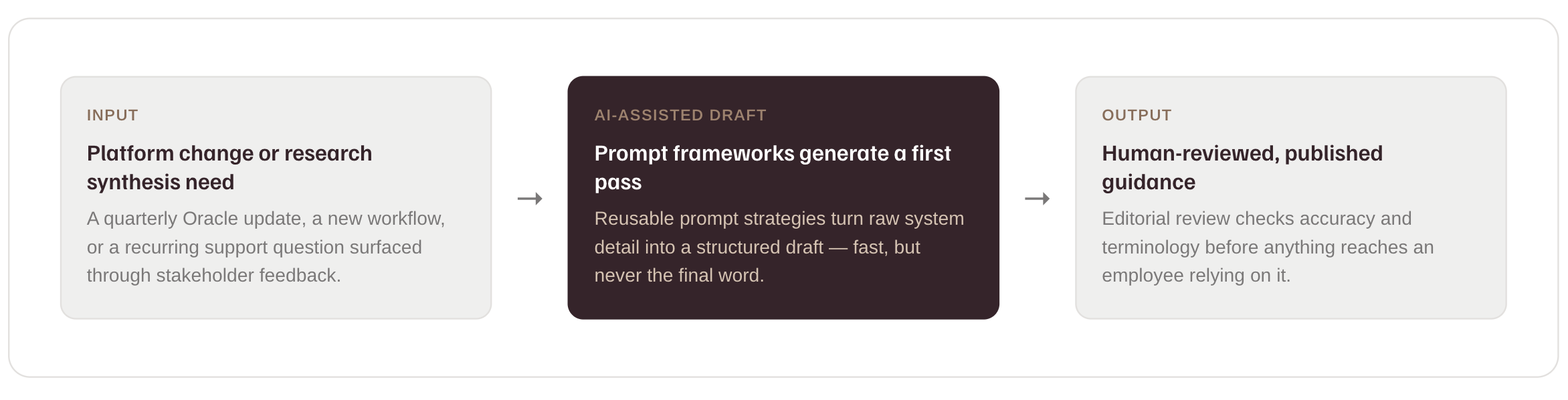
Why: documentation that took months to update couldn't keep pace with quarterly platform changes
The content operations pipeline
The redesign
04
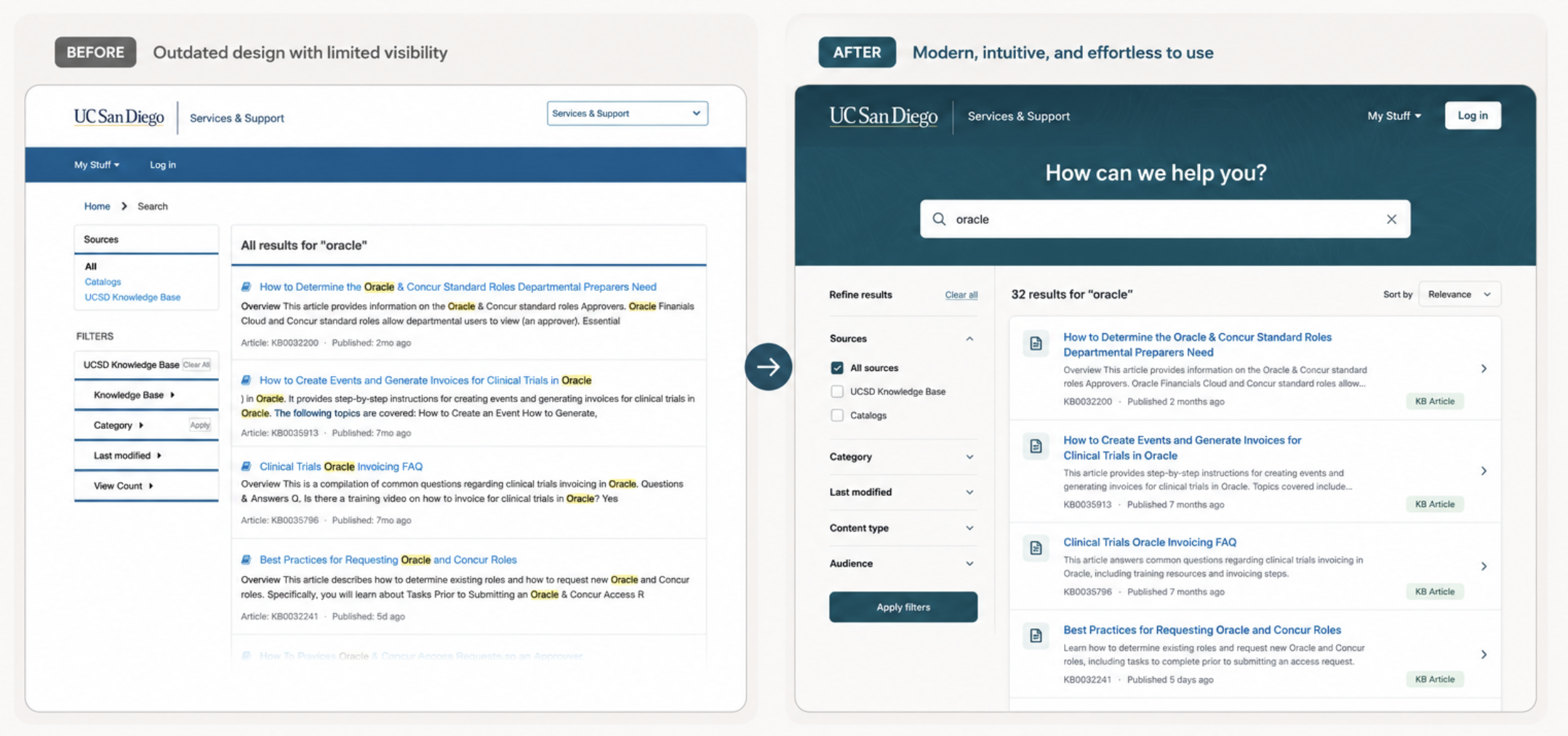
The workflow remained unchanged, but the support experience was fundamentally redesigned. By rethinking the content strategy, information architecture, and UX writing, I transformed fragmented documentation into a cohesive guidance system that improved discoverability, reduced friction, and helped users complete complex tasks with confidence.
A department-specific cheat sheet, rewritten as shared enterprise guidance
Why: this exact fragmentation pattern was named directly in stakeholder feedback
Before · department-written cheat sheet
"For the PO thing, go into Oracle, find the requisition module (not the one that says Procurement, the other one), and if it's over the threshold you'll need to loop in your AP contact before submitting, otherwise it might bounce back."
— Representative of internally-authored, department-specific guidance circulating before content standards were established.
After · standardized enterprise guidance
To submit a purchase requisition above your department's threshold: navigate to Oracle Procurement > Requisitions. Requisitions exceeding the threshold route automatically to the designated Accounts Payable approver; no manual escalation required.
What changed in the rewrite, and why
Replaced tribal knowledge with explicit guidance
Removed informal references such as "the other one" and "it might bounce back," replacing them with the correct module names and navigation paths so success no longer depended on institutional knowledge or verbal workarounds.Eliminated legacy process assumptions
Identified documentation that described workarounds for behaviors that no longer existed. Updated guidance to reflect the current Oracle workflow, removing unnecessary steps and reducing user confusion.Established a shared content taxonomy
Standardized terminology across documentation by replacing inconsistent language (for example, "the PO thing") with canonical system terms such as "purchase requisition," creating a consistent experience regardless of department or author.Validated against the live product
Verified every workflow against the production environment before publication, ensuring documentation reflected how the system actually worked rather than how it had functioned under the legacy platform.
Supporting work
05
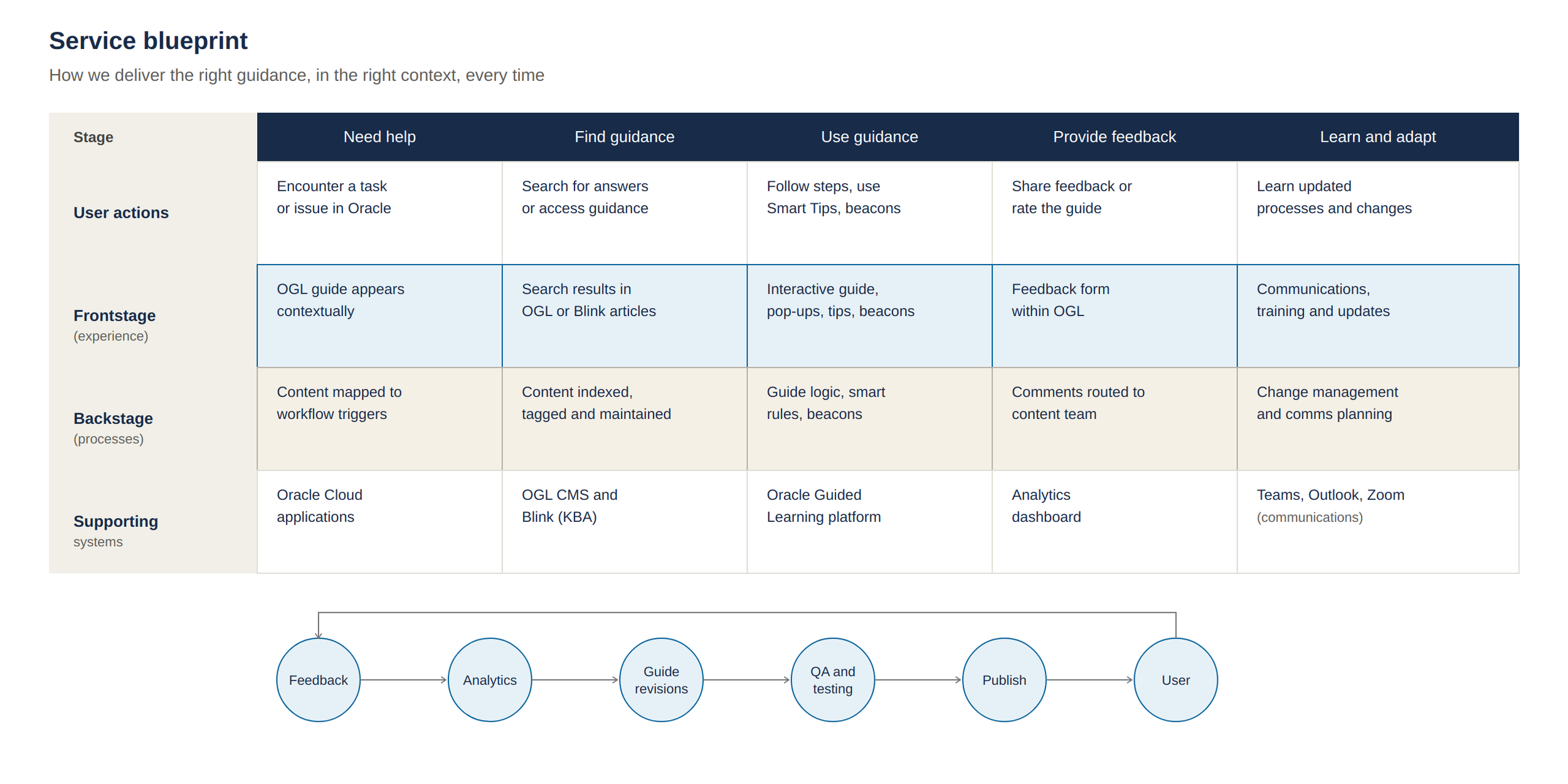
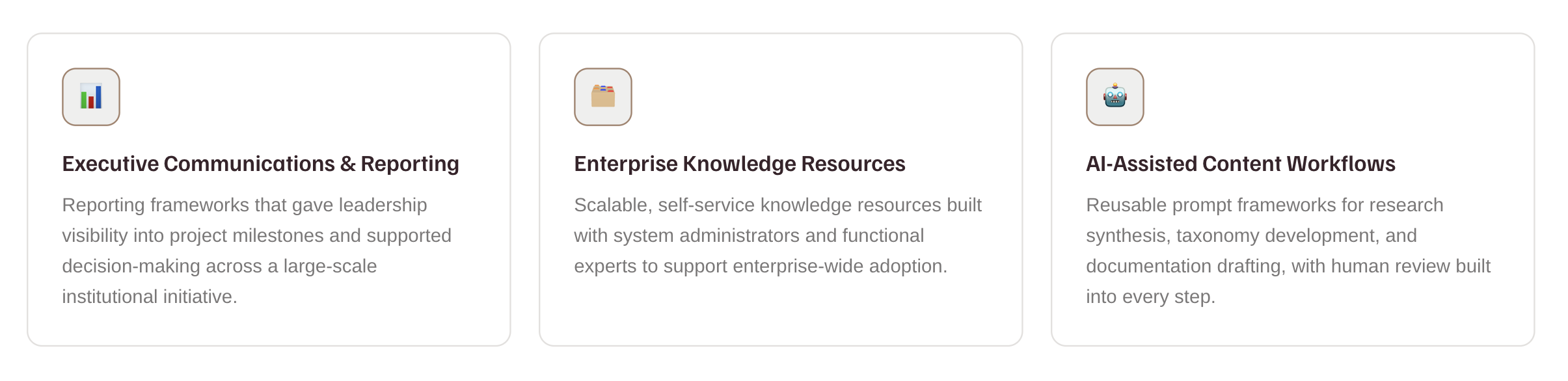
Documentation was one part of a broader content operation spanning executive communication and enterprise-wide training.
Enterprise documentation only works if the people relying on it trust it, and if leadership has visibility into how the rollout is actually going. Alongside the documentation work, I built the supporting communications and knowledge infrastructure to keep both intact.
Impact
06
Established as the enterprise-wide documentation standard for Oracle Cloud ERP, structurally embedded into how Business & Financial Services supports the platform going forward.
40,000+
employees supported by the documentation and guidance this work produced
——————————————————
Full population with standing access to the Oracle financial system.
1 standard
shared terminology and editorial system replacing fragmented, department-specific guidance
——————————————————
Core outcome of the content governance work.
Continuous
AI-assisted content cadence, replacing a slower, manual documentation cycle
——————————————————
Built to match Oracle's quarterly platform update schedule.
Reflection
07
What I'd revisit, and what I'd carry into any future enterprise content operation.
What I'd change
I'd push for a tighter feedback loop between system administrators and content earlier. Some documentation gaps were only caught after employees had already been working around them informally for months.
The AI-assisted drafting workflow accelerated content production, but I'd want clearer logging of what was AI-drafted versus human-written, for easier auditing later.
Department-specific guidance didn't disappear overnight just because a shared standard existed. I'd plan a more active migration period instead of expecting organic adoption.
What I'd carry forward
Treating documentation speed as a requirement, not a nice-to-have, matters anywhere the underlying system changes faster than people expect, not just in enterprise software.
AI is genuinely useful for first drafts and synthesis, but the moment guidance touches real financial or operational decisions, a human checkpoint isn't optional.
A shared taxonomy is worth the upfront coordination cost; it's the difference between fixing an error once and fixing it in twelve different department documents.